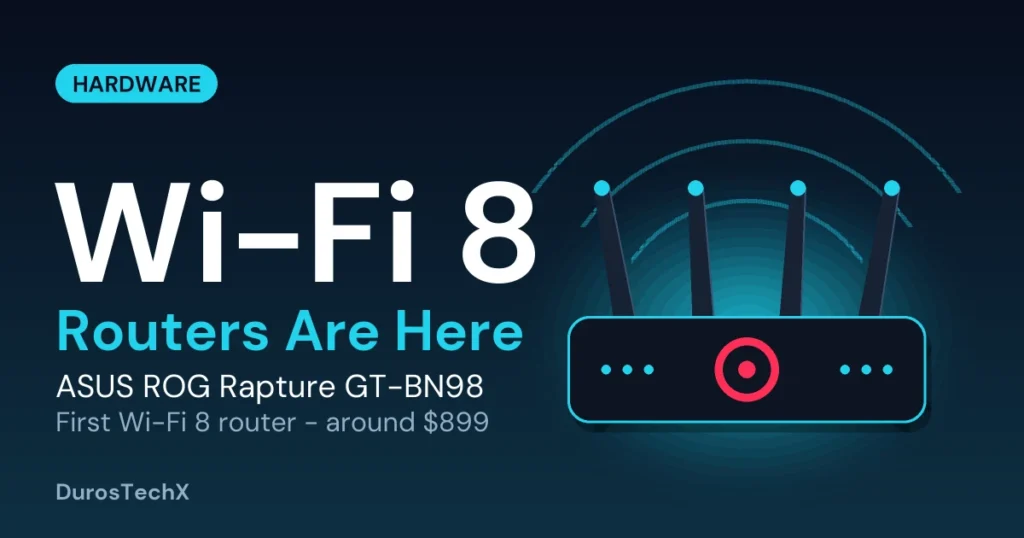
On October 6, 2026, the world’s first Wi-Fi 8 gaming router started shipping — nearly two years before the wireless standard it runs on is expected to be finalized. The ASUS ROG Rapture GT-BN98, priced around $899, is built on a draft of the IEEE 802.11bn specification, and its arrival means Wi-Fi 8 has officially moved from lab slides to something you can buy today.
So what is Wi-Fi 8, what does this router actually do differently, and should you spend $899 on one right now? Let’s break it down.
What Wi-Fi 8 actually is
Every Wi-Fi generation so far has been about one thing: going faster. Wi-Fi 6 and Wi-Fi 7 raised the ceiling on throughput with wider channels and denser modulation, and they did it well. Wi-Fi 8 is the first generation to change the goal.
Formally known as IEEE 802.11bn, Wi-Fi 8 carries the nickname “Ultra High Reliability” (UHR) — and that name tells you exactly where the engineering went. Instead of pushing peak speeds higher, the standard is designed around three practical targets:
- 25% more throughput at a given signal quality level
- 25% lower 95th-percentile latency (the lag spikes that ruin competitive gaming matches)
- 25% less packet loss, especially when devices switch between access points
Here’s the part that surprises most people: Wi-Fi 8 shares the same theoretical ceiling as Wi-Fi 7 — roughly 23 Gbps — using the same bands (2.4 GHz, 5 GHz, and 6 GHz), the same 320 MHz maximum channel width, and the same 4096-QAM modulation. On a spec sheet, a Wi-Fi 7 router and a Wi-Fi 8 router look identical at the headline numbers.
The difference is what happens in a real home. Wi-Fi 8 is engineered for the messy reality — walls, interference from neighbors, twenty devices fighting for airtime, someone streaming 4K while someone else is in a ranked match.
How Wi-Fi 8 improves your connection
The 802.11bn standard introduces three protocol-level mechanisms that explain how those reliability targets get hit. This is the technical core of the story, and it’s worth understanding before you decide anything.
1. Smoother speed adjustments
Wi-Fi connections manage weakening signals through a ladder of settings called Modulation and Coding Scheme (MCS) levels — essentially a set of speed-and-reliability tradeoffs the connection steps down through as conditions worsen. The problem with older standards: the steps on that ladder were far apart, so moving down one rung meant an abrupt, noticeable speed drop.
Wi-Fi 8 adds four new intermediate steps between the existing levels. The connection can now make smaller, more gradual adjustments instead of falling off a cliff when you walk into the next room. The standard’s own documentation puts the resulting throughput improvement at 5–30% depending on conditions — with the biggest gains exactly where you’d expect: at medium distance, where old standards collapsed suddenly.
2. Using channels that would otherwise sit idle
Wide Wi-Fi channels are divided into a primary sub-channel and several secondary sub-channels. Traditionally, the secondary channels waited for the primary one to be free before carrying traffic. Non-Primary Channel Access (NPCA) changes that: the router can use available secondary sub-channels while the primary channel is congested — by a neighbor’s router, a chatty smart-home gadget, or your own background downloads.
3. Smarter use of multiple antennas
In a multi-antenna (MIMO) connection, every stream has traditionally been forced to use the same modulation level — so the weakest antenna path bottlenecked the whole link. Unequal Modulation (UEQM) lets each stream run at its own optimal level, so strong paths stay fast while only the weak ones slow down.
Together, these three mechanisms target one specific failure mode: the wireless link staying steady when the network is busy and conditions are imperfect — not just when one person sits next to the router in an empty house.
The ASUS ROG Rapture GT-BN98: what’s inside
ASUS unveiled the GT-BN98 at Computex 2026 and confirmed worldwide availability from October 6, 2026. It is a quad-band router covering 2.4 GHz, two separate 5 GHz bands, and 6 GHz, with combined wireless throughput rated at up to 25,000 Mbps — an aggregate figure across all four bands under ideal conditions, not a rate any single device will reach.
The hardware is unapologetically flagship-grade: a 2.6 GHz quad-core processor, 2 GB of RAM, eight external antennas, and 60W maximum power draw. Where the GT-BN98 stands out most is wired connectivity — two 10 Gigabit Ethernet ports plus several 2.5 GbE and 1 GbE ports: six wired connections at 2.5 Gbps or faster, enough for a gaming PC, a NAS, a second PC, and room to spare. Two USB ports support network-attached storage.
The software side includes three notable features. Adaptive QoE reallocates bandwidth dynamically based on current demand rather than fixed rules — keeping gaming responsive while streams and downloads compete. WiFi Insight continuously scans for interference across all bands, including non-Wi-Fi sources like Bluetooth devices and microwave ovens, and shows a 24-hour interference history — genuinely useful for apartment dwellers. And GTNet routes gaming traffic through the lowest-latency path to game servers, independent of the Wi-Fi 8 standard itself.
There’s also ASUS’s AiProtection suite built in: network-level malicious site filtering, infected device blocking, and ad and tracker filtering for every device on the network. For households with gadgets that can’t run their own security software, router-level protection is a meaningful first line of defense.
Who else is racing to Wi-Fi 8
ASUS beat its rivals to retail, but it isn’t alone. TP-Link teased its Archer 8 router targeting an October 2026 launch, with a Deco 8 mesh system (Q1 2027) and a Roam 8 travel router (Q2 2027) to follow. On the silicon side, Broadcom has unveiled its first Wi-Fi 8 chipsets, MediaTek has announced its Filogic 8000 Wi-Fi 8 chip family, and Qualcomm’s FastConnect 8800 — its first mobile Wi-Fi 8 chipset, announced at MWC 2026 — is expected in phones and laptops from late 2026 into 2027. That last point matters enormously.
The draft-standard elephant in the room
Every Wi-Fi generation has shipped on pre-ratification hardware — Wi-Fi 7 routers were available in 2023 before the 802.11be standard was ratified in March 2024. But the gap this time is unusually wide. The IEEE 802.11bn task group targets ratification between May and September 2028. The GT-BN98 is shipping roughly two years early.
The practical consequence: the router is sold as an “802.11bn (Draft)” product, and ASUS’s own spec page carries a disclaimer that it makes no representations or warranties about the product’s compatibility with future standards. Historically, draft hardware has ended up compatible with the ratified standard — but buyers today are purchasing hardware whose firmware will chase a specification that is still being written.
The client-device problem
Here’s the bigger constraint — and it’s not about the router at all. There are currently no Wi-Fi 8 client devices in stores: no phones, no laptops, no adapters. The three headline mechanisms (UEQM, NPCA, and extended MCS levels) all require a Wi-Fi 8 chipset on both ends, so connecting your current Wi-Fi 7 laptop to the GT-BN98 won’t activate them.
Real Wi-Fi 8 client devices — powered by chips like Qualcomm’s FastConnect 8800 — are expected from late 2026 into 2027. A premium router typically serves a household for five years or more, so a buyer upgrading their phone or laptop in 2027 would still be well inside that window.
Wi-Fi 8 vs Wi-Fi 7: which should you buy?
This is the comparison that actually matters for most shoppers. ASUS’s own Wi-Fi 7 flagship, the ROG Rapture GT-BE98 Pro, sells for around $800 on a fully ratified standard, with a wide selection of compatible client devices already in the market.
The honest breakdown:
Buy Wi-Fi 7 if you need the best available today. It’s ratified, mature, discounted from launch pricing, and your current devices support it. For most households, it’s the rational choice.
Consider the GT-BN98 if you need serious wired networking today. The dual 10 GbE ports and multiple 2.5 GbE connections are generation-agnostic and genuinely useful right now for multi-gigabit internet or fast local storage. You’re effectively buying a premium 10 GbE hub that will grow into Wi-Fi 8 as your devices catch up.
Wait if you’re on Wi-Fi 6 and your network works fine. Router hardware will only get cheaper and more finalized through 2027 as client devices arrive and the specification matures.
What Wi-Fi 8 means for gamers
For competitive players, Wi-Fi 8’s pitch is the most direct: the 25% reduction target in 95th-percentile latency is specifically the metric for the lag spikes that lose matches. Wireless still isn’t equivalent to Ethernet — but the gap is narrowing in exactly the dimension that matters for play. For a broader look at squeezing more out of your setup, see our full guide to better gaming performance. And if you game on Linux, our Linux gaming performance tweaks still apply no matter what router you buy — Wi-Fi 8 fixes the wireless link, not the machine at the end of it.
Even for non-competitive play, steadier connections matter more than most people realize. Open-world games that stream assets continuously — think of the scale of what we’ve covered in everything we know about GTA 6 — punish inconsistent connections with pop-in, stutter, and degraded image quality long before raw download speed becomes the bottleneck.
The AI angle nobody is talking about
One quieter trend visible in this launch: routers are becoming AI-managed devices. TP-Link’s Archer 8 advertises AI-assisted network intelligence for thermal management and RF optimization; ASUS’s Adaptive QoE reallocates bandwidth based on live demand. The router on your shelf is quietly becoming one more device that adjusts itself rather than waiting for you to configure it — another small example of how AI is changing everyday life, this time inside the box that connects everything else.
The bottom line
Wi-Fi 8 is real, it’s shipping, and its design philosophy — reliability over raw speed — is the right call for where wireless networks actually struggle. The ASUS ROG Rapture GT-BN98 is genuinely impressive hardware with wired networking that justifies much of its $899 price today. But be honest about what you’d be buying: a draft-standard wireless radio whose headline features are currently inert, with no client devices to unlock them until late 2026 or 2027.
Our verdict: if you need a premium router with serious wired connectivity right now, the GT-BN98 is a future-proofed purchase with real present-day value. If you’re buying for the Wi-Fi 8 label alone, wait. The standard gets finalized in 2028, client devices arrive through 2027, and the patient shopper will pay less for more — on hardware that no longer carries a “draft” disclaimer.