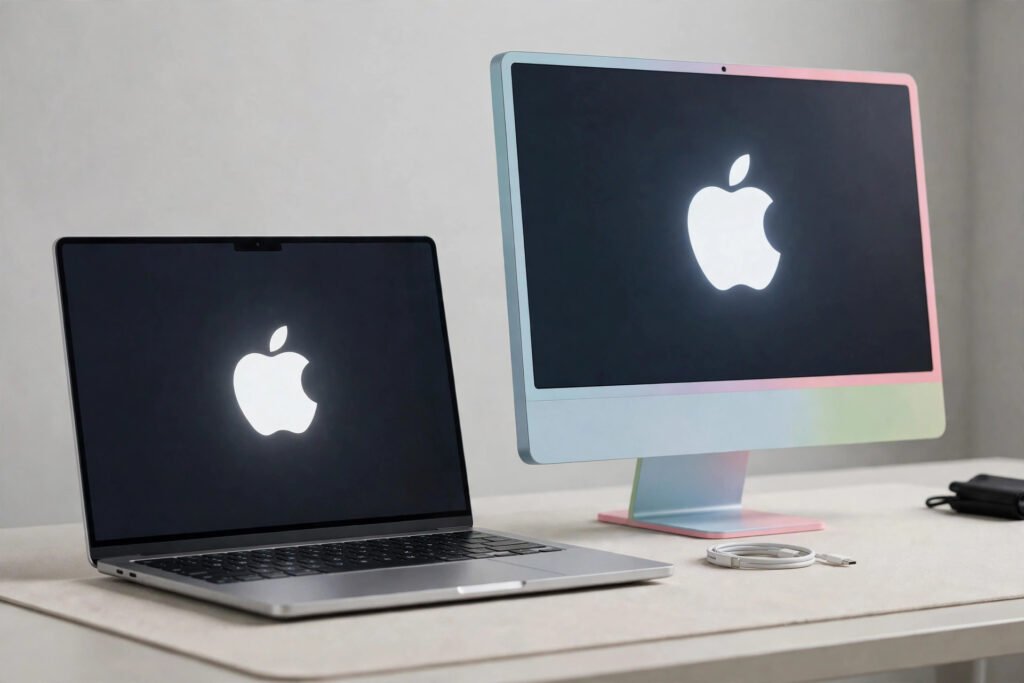
Apple has had a very busy week, and it has not even held its event yet. In two days, the company announced three new products by press release: a redesigned OLED iPad mini on October 26, then a new 14-inch MacBook Pro and a new 24-inch iMac, both powered by the M6 chip, on October 27. Pre-orders for all three open today, October 28, with availability from Friday, November 6.
Then there is tonight. Apple is holding an in-person “Pro and Tell” launch experience in Los Angeles on October 28, where Bloomberg’s Mark Gurman and others report the company will show its first touchscreen MacBook Pros. Apple has not confirmed those machines. That split — three real products you can order tonight, and one big rumoured product you cannot — is what makes this a confusing week to buy a Mac. This guide separates what Apple has actually announced from what is only reported, and gives you a straight answer on whether to buy now or wait.
Confirmed vs rumoured: read this first
Confirmed by Apple: the OLED iPad mini with A20 Pro, the 14-inch MacBook Pro with M6, and the 24-inch iMac with M6 — specs, prices, pre-order date (October 28) and release date (November 6).
Reported, not confirmed: touchscreen OLED MacBook Pros in 14-inch and 16-inch sizes, with a Dynamic Island instead of a notch, thinner and lighter designs, and M5 Pro and M5 Max chips. Those details come from Bloomberg and other outlets, not from Apple, and they could change when the event happens.
The M6 MacBook Pro: a faster chip in the same laptop
The headline product is the new 14-inch MacBook Pro with M6, starting at $1,999. Apple has kept the design, display and port selection of the outgoing M5 model and changed what is inside it. The M6, built on a 2-nanometre process, has a 12-core CPU and 12-core GPU plus a Dual 16-core Neural Engine. Apple says graphics are up to 30 percent faster than the M5 model and on-device AI work up to 25 percent faster — Apple’s own figures, not independent benchmarks. If your AI workloads are mostly video, our roundup of the best free AI video generators that actually work shows what these Neural Engines are for day to day.
The rest of the machine is familiar, and that is the point. You get a 14.2-inch Liquid Retina XDR display, up to 24 hours of battery life — which Apple calls the longest ever in a Mac — Wi-Fi 7 and Bluetooth 6 via Apple’s new N1 wireless chip, three Thunderbolt 4 ports, HDMI, an SDXC card slot, MagSafe 3 and a 12MP Center Stage camera. It comes in Space Black and Silver, with 16GB of memory and 1TB of storage as standard, configurable up to 32GB and 4TB.
Who should buy the M6 MacBook Pro?
Owners of Intel Macs or early M1 machines. The clearest upgrade in the lineup: the newest chip, modern wireless and a full day of battery.
Students and professionals buying their first MacBook Pro. At $1,999 ($1,899 with education pricing), this is the cheapest MacBook Pro with the newest chip — $500 less than the $2,499 M5 Pro model.
Anyone who works mostly on the go. The 24-hour battery claim and the portable 14-inch size are the real selling points, more than the chip bump itself.
Who should skip it?
M5 MacBook Pro owners. The design, display and battery are identical to your machine; a 25–30 percent Apple-quoted speed bump is not a reason to spend $1,999 a year later.
Heavy video, 3D or music professionals. The M5 Pro and M5 Max models stay on sale alongside this machine, and they are built for sustained professional workloads.
Anyone who specifically wants a touchscreen or a redesigned Mac. That machine, if it exists, is expected tonight — and waiting costs you nothing, because nothing ships until November 6 anyway.
If you are weighing a Mac against a Windows laptop instead, our buying guide to Microsoft’s Surface Laptop Ultra with RTX Spark frames the trade-offs differently from Apple’s approach.
The M6 iMac: the bigger upgrade of the two Macs
The iMac is arguably the more meaningful update of the pair, because it is jumping two chip generations. The last iMac used the M4 chip from 2024; the new 24-inch model moves to M6, and Apple claims up to twice as fast graphics and up to five times faster on-device AI than the M4 iMac.
There are two configurations. The $1,499 model has a 10-core CPU and 10-core GPU, 16GB of memory, 256GB of storage and two Thunderbolt 4 ports. The $1,699 model steps up to the full 12-core CPU and 12-core GPU and four Thunderbolt 4 ports. Everything else carries over: the 24-inch 4.5K Retina display, the 12MP Center Stage camera with Desk View, the six-speaker sound system, and the same seven colours — blue, green, pink, yellow, purple, orange and silver.
The practical advice here is simple: the $200 step-up is worth it if you use an external monitor setup or keep many apps open at once, because you are buying ports and headroom, not storage — both models still start at 256GB, so budget for a larger SSD or external drive if you keep a big photo or video library.
The OLED iPad mini: the surprise star of the week
Announced a day earlier, on October 26, the new iPad mini is the biggest redesign of Apple’s smallest tablet ever. The display grows from 8.3 inches to 8.5 inches while the body gets thinner (5.4mm, down from 6.3mm) and lighter (255g for Wi-Fi), because the bezels are 24 percent thinner. More importantly, it is an OLED panel: per-pixel lighting, a 2,000,000:1 contrast ratio and up to 1,200 nits of peak brightness, more than double the old LCD. Inside is the A20 Pro, with Apple claiming up to 2.7 times faster graphics and up to 4.5 times faster AI performance than the old A17 Pro mini. Note one catch: the 512GB model gets a 6-core CPU and Dual Neural Engine, while the 128GB and 256GB models get a 5-core CPU and a single Neural Engine. Add IP67 water and dust resistance — a first for iPad mini — plus Wi-Fi 7 and a 12MP Center Stage camera, and this is a genuinely different device.
The price, however, is the sting. It starts at $699 for Wi-Fi and $849 for Wi-Fi + Cellular — $100 more than the A17 Pro model cost the day before the announcement, and $200 more than its original 2024 launch price. It comes in just two finishes, Midnight and Starlight, with a $100 nano-texture glass option on the 256GB and 512GB models. If you read on a tablet every day, travel light, or want a small device for notes and media, the OLED screen alone justifies the upgrade. If you only use a tablet occasionally, the price rise makes this a harder impulse buy than the old mini was.
Tonight’s “Pro and Tell” event: what is reported, and why waiting is free
Apple’s Los Angeles event on October 28 is an in-person media experience, not a streamed keynote, and it starts at 10 a.m. Pacific (10 p.m. Pakistan time). Here is what reporting says to expect:
Touchscreen OLED MacBook Pros, 14-inch and 16-inch, with OLED displays, touch support, a Dynamic Island replacing the notch, and thinner, lighter builds. Reported by Bloomberg.
M5 Pro and M5 Max chips, not M6 Pro or M6 Max. Multiple outlets report Apple is skipping the M6 Pro/Max generation to focus on an M7 family for 2027. That would mean the premium touchscreen models are actually a chip generation behind the $1,999 M6 machine — you would be paying for the screen and the redesign, not for more speed.
Higher prices. Reports put the touchscreen models roughly $300–$500 above the current M5 Pro prices, which would mean around $2,800–$3,000 for the 14-inch and $3,300–$3,500 for the 16-inch. Those are reported estimates, not Apple prices.
That last point is the reason the advice in this article is so simple: pre-orders for the confirmed products open tonight, and nothing ships until November 6. If you wait until tomorrow morning, you will know whether the touchscreen Macs are real, what they cost, and whether they are worth it — and you will still be able to pre-order the M6 MacBook Pro, M6 iMac or iPad mini for the same November 6 delivery. Waiting a few hours costs nothing; ordering tonight, before the event, risks buying the wrong Mac.
The buying guide: which Apple machine, for whom
| If you are… | Buy this | Why |
|---|---|---|
| Upgrading from Intel or M1, need portability | M6 MacBook Pro, $1,999 | Newest chip, 24-hour battery, lowest Pro price |
| A desk-based creator or family computer buyer | M6 iMac, $1,699 (12-core) | Built-in 4.5K display, camera and speakers; two generations of speed |
| A reader, traveller or note-taker | OLED iPad mini, $699 | OLED screen, 255g, IP67, A20 Pro |
| A pro who needs maximum sustained power | Wait, or M5 Pro/Max (existing) | Base M6 is not the pro-tier chip; M7 is reported for 2027 |
| Specifically waiting for a touchscreen Mac | Wait until after tonight’s event | Reported prices start near $2,800; nothing ships before Nov 6 |
A final note: all three new products move to Wi-Fi 7, which only helps if your home network can keep up — see our guide to Wi-Fi 8 routers and whether the first ones are worth buying for what the new wireless standards change in a real home.
Verdict
This is a good week to buy a Mac, and a bad morning to rush one. The M6 MacBook Pro is the sensible default laptop, the M6 iMac is the bigger generational leap, and the OLED iPad mini is the most improved product of the three — all with confirmed specs, confirmed prices and a November 6 release date. But the most interesting Mac of the week may not have been announced yet. Wait until tonight’s “Pro and Tell” event is over, compare the real touchscreen prices against the $1,999 M6 MacBook Pro, and then order. You lose nothing by waiting, and you might save yourself a $1,000 mistake. See also our verdict on Apple’s first foldable iPhone Duo.
Quick answers
When do pre-orders open? October 28 at 10:10 a.m. Pacific (10:10 p.m. Pakistan time), for all three products.
When do they ship? Friday, November 6.
Is the touchscreen MacBook Pro confirmed? No. It is widely reported by Bloomberg and others for tonight’s October 28 event, but Apple has not announced it.
Should M5 MacBook Pro owners upgrade to M6? No — the design, display and battery are unchanged, and the speed gain alone does not justify $1,999.