Apple’s first foldable iPhone went on sale Friday — and by the time most people had finished their morning coffee, it was gone. Pre-orders for the iPhone Duo opened on October 16, and within minutes every configuration slipped to a January 2027 delivery date. The phone officially launches on October 23 in more than 70 countries, but if you didn’t get your order in during the first half hour, you’re not getting one this year.
That sellout makes this the exact right moment for a buying guide — not a hype piece. Because the real question isn’t whether the Duo is impressive. It’s whether you, specifically, should spend $1,999 on a first-generation foldable you can’t even get until next year. Let’s work through it honestly.
What the iPhone Duo actually is (and what Apple confirmed)
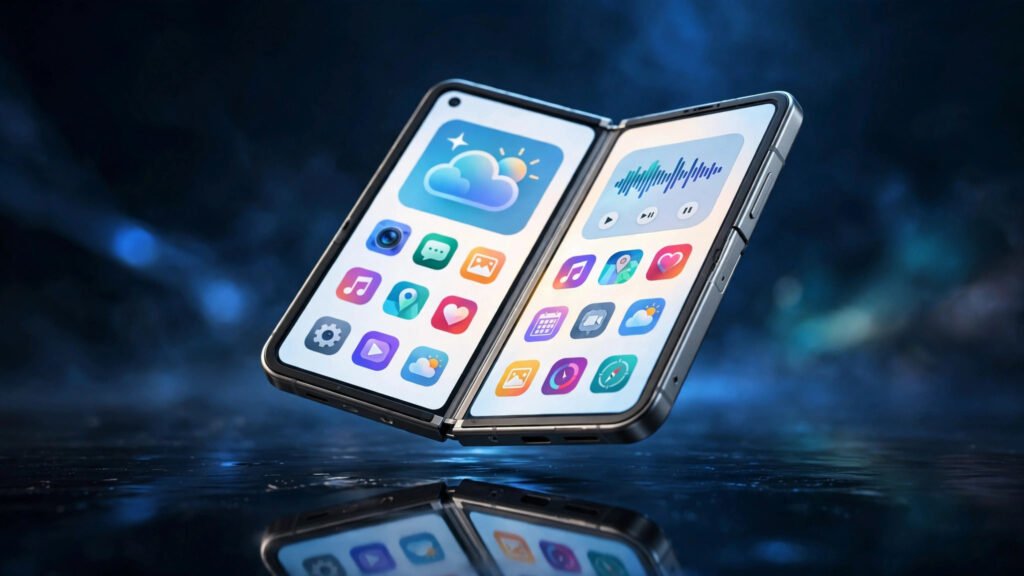
The Duo is a book-style foldable: a 5.4-inch cover display on the outside that opens into a 7.6-inch inner screen — the largest display Apple has ever put on an iPhone. The inner panel is a Super Retina XDR display with 120Hz ProMotion, always-on, and a matte nano-texture coating that Apple says cuts glare and minimizes how visible the crease is.
Inside is the A20 Pro chip — the same 2nm silicon as the iPhone 18 Pro — paired with an upgraded C2 modem. Cameras: two 48MP sensors (main and ultra-wide). Note what’s missing: no telephoto lens and no Face ID. Authentication is Touch ID built into the side button, and the inner FaceTime camera sits under the display.
The build is a Grade 5 titanium frame, 5.2mm thin when open (the thinnest iPhone ever made), 254 grams, with a dual-battery design Apple rates at up to 24 hours. It’s eSIM-only — there is no physical SIM tray. Two colors: Star White and Night Sky. Pricing runs $1,999 (256GB), $2,199 (512GB), $2,599 (1TB), and $3,199 (2TB).
A note on sourcing: the figures above come from Apple’s announcement and launch coverage. Treat supply-chain numbers you’ll see elsewhere — production volumes, brightness claims — as reported rather than confirmed unless Apple itself said it.
The price math nobody does for you
$1,999 is the headline, but the comparison that matters is against the iPhone 18 Pro at roughly $1,099. Same A20 Pro chip. Same two 48MP cameras. So the roughly $900 premium buys you exactly two things: the folding mechanism and the bigger screen. Not speed. Not better photos.
That’s not a criticism — it’s the entire point of a foldable. But be honest with yourself about whether you’ll use a 7.6-inch canvas often enough to justify nearly double the price. In the UK the gap is even starker: £1,999 for the Duo is £700 more than the iPhone 18 Pro Max. In India it’s Rs 2,99,900 — Apple’s most expensive iPhone there to date.
Ways to soften the blow: US carriers are offering the Duo from around $55/month, with up to $1,200 off through trade-in deals. And if that $1,999 figure makes your wallet flinch, the sensible alternative is already covered on this site — our iPhone 17e review walks through where the money actually goes when you buy Apple’s value pick instead of its halo product.
Pakistan: the Duo isn’t coming here yet (and it’ll cost you)
Pakistan is not in the October 23 launch wave, nor in the October 30 second wave, and there is no official Pakistani price yet. What we know: $1,999 converts to roughly PKR 553,703 before any tax — and that’s the fantasy number. Lahore importers were taking non-PTA pre-orders from PKR 730,000 (256GB) up to PKR 1,140,000 (2TB) before the global sellout, and with worldwide backorders now stretching into January, grey-market premiums will run higher still.
Daily Pakistan expects a PTA-approved price around PKR 787,100 once official stock lands. On the tax side, projections put PTA tax at roughly PKR 155,406 on a passport or PKR 183,597 on a CNIC — but treat those as projections only, because the FBR hasn’t issued a valuation ruling for the Duo yet.
Realistic timeline: grey-market units from the last week of October at steep premiums; official distributor stock in November at the earliest — and frankly, with every launch market on earth backordered to January, later is likelier. If you’re in Pakistan and must have it in 2026, budget well over a million rupees all-in for a non-PTA unit. Everyone else: wait.
The supply situation is genuinely bad
This isn’t manufactured-scarcity theater — or at least, not only that. Within about half an hour of pre-orders opening, every color and storage combination showed January 25, 2027 delivery (some buyers saw January 29). Nikkei Asia reported Apple making just a few hundred units a day, far behind a normal iPhone ramp. Bloomberg’s Mark Gurman described “extraordinary” supply-chain constraints, and Apple reportedly came close to slipping the entire launch to November. Supply-chain sources put Foxconn’s final-assembly yield on the Duo’s hinge at roughly 60% — meaning four in ten units fail checks before they ever reach a box. That’s reported, not Apple-confirmed, but it matches everything else we’re seeing.
Analysts aren’t shocked: IDC notes foldables are only about 2% of global phone shipments but nearly 7% of industry revenue — “Duo is fast becoming an aspirational foldable,” in analyst Nabila Popal’s words. Apple itself told the Financial Times that demand has been “exceptional.”
What this means for you:
- There will almost certainly be no walk-in stock on October 23. Apple has told retail staff to warn customers against queuing without a pre-order, and its site says to check pickup availability on October 24 — with no promises.
- Do not buy from scalpers. eBay listings are asking up to $5,200 for a $1,999 phone. Waiting saves you roughly $3,000 and a great deal of regret.
The honest trade-offs of a first-gen foldable
Every first-generation foldable has a list. Here’s the Duo’s:
The crease. It’s there — every foldable has one. Apple’s answer is the nano-texture coating, and hardware engineering VP Tom Marieb told TechRadar in September: “Hold us accountable” on it. That’s a bold quote to live up to, and the real test comes when reviewers spend extended time with retail units.
No telephoto, no Face ID. The 18 Pro gives you both for $900 less. If zoom photography or face unlock matter to you, that’s a genuine downgrade.
Weight and thickness. 254 grams folded is noticeably heavier than a standard iPhone, and folded it’s roughly twice as thick. It won’t disappear into a pocket.
App optimization. Some apps won’t be optimized for the unfolded 7.6-inch screen on day one. Early foldable software always has rough edges — awkward aspect ratios, apps that don’t know what to do with the extra space.
No stylus at launch. Apple Pencil support arrives through a software update later this year, not on day one. If pen input is your reason for wanting a big folding screen, wait.
Repairs are brutal. Out-of-warranty repair fees run up to $1,499 without AppleCare+. On a $1,999 first-generation device with a hinge, AppleCare+ isn’t optional — it’s part of the true cost.
The software story: multitasking and AI
The Duo ships with the new iOS 27 release, including fold-specific multitasking — the whole justification for the big screen is running apps side by side and dragging content between them. And this is where Apple’s AI push matters: a smarter Siri and on-device Apple Intelligence features are the software that makes a 7.6-inch canvas genuinely useful rather than merely big. We’ve been tracking how these AI features land in daily use — our look at how AI is changing everyday life in 2026 is a good reality check on what’s actually useful versus demo-ware.
That big display is also a better stage for creative work — photo editing, layout, and the new wave of AI creativity tools that turn text prompts into images. If that’s your thing, our explainer on how text prompts are transforming digital creativity shows what the current generation of tools can actually do.
So: should you buy it?
Buy it if: you’re a multitasker who will genuinely live on the 7.6-inch screen — split-screen email and documents, reading, travel planning, presentations. You’re comfortable being an early adopter, crease and all. And you can actually get one — which realistically means you ordered in the first 30 minutes, or you’re willing to wait until 2027.
Don’t buy it if: you mostly use your phone one-handed for messaging, photos, and social apps. The 18 Pro (or the 17e, for the budget-conscious) gives you the same chip and cameras for far less. And don’t buy it out of FOMO — the sellout is a supply story, not a sign that waiting costs you anything. The phone will be a better product in six months anyway: more optimized apps, stylus support live, and actual stock on shelves.
The contrarian take: the smartest iPhone Duo buyers in October 2026 are the ones who wait. Prices won’t drop — Apple doesn’t do that — but availability, software maturity, and your own clarity about whether you need a folding phone will all be better by spring.
If you’re buying one anyway: five practical tips
- Order online; don’t queue. Walk-in stock on October 23 will be effectively zero. If you missed pre-orders, check Apple’s pickup availability on October 24 — retail allocations are separate from online orders.
- Get AppleCare+. With repair fees up to $1,499, this is non-negotiable on a first-generation foldable.
- Think about storage honestly. 256GB at $1,999 is the sane pick. The jump to 2TB costs $3,199 — that’s $1,200 for storage you’ll probably never fill.
- Check the eSIM situation. The Duo is eSIM-only. If your carrier or your travel habits depend on physical SIMs, sort that out before the phone arrives.
- Don’t feed the scalpers. $5,200 on eBay versus $1,999 retail — patience is worth three grand here.
Verdict
The iPhone Duo is the most interesting iPhone in a decade — and the hardest to recommend without caveats. It’s a genuinely impressive piece of engineering with a supply chain that can’t build it fast enough, a price that demands you actually use the folding screen, and a first-generation rough edge or two that Apple is asking you to trust them on. If you’re the multitasker it’s built for, it’s worth the wait until 2027. If you’re not sure — you’re not, and the 18 Pro is the better buy.