Apple’s First Smart Display Has Arrived — and the First Reviews Are Already Complicated
After years of rumours, delays and one very public wait for Siri to catch up, Apple’s first smart display is finally in people’s homes. The Apple HomeView starts reaching customers today, Friday 13 November 2026, priced at $299. Early reviews landed yesterday, and they tell a familiar Apple story: a beautifully made device that does its core job superbly, with two catches big enough to change the buying decision for a lot of households.
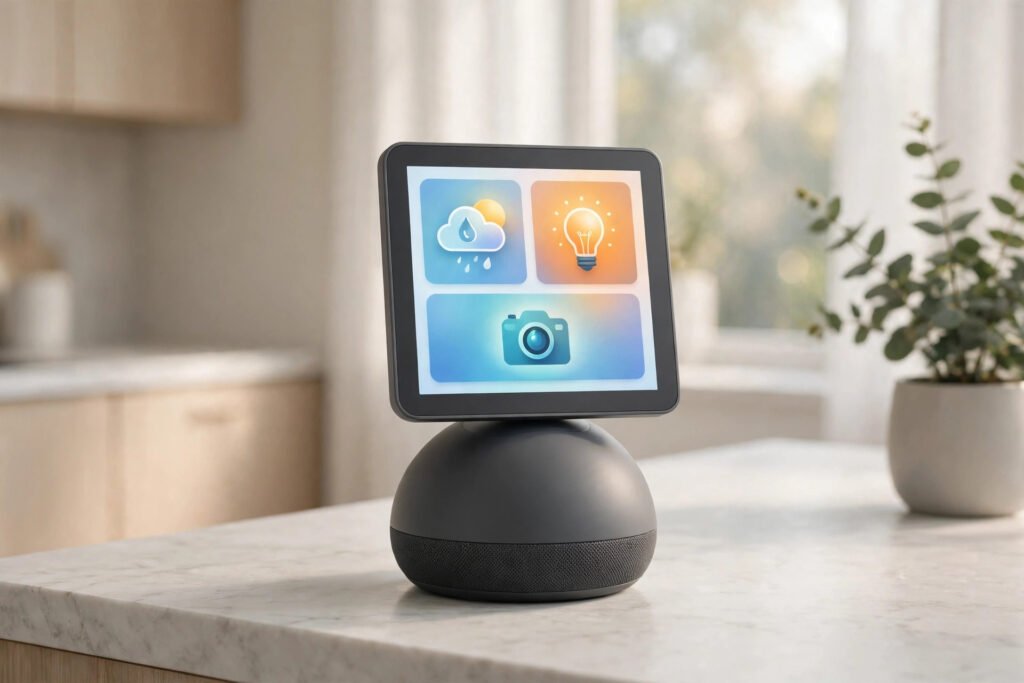
Apple HomeView is Apple’s answer to a category Amazon and Google have owned for nearly a decade: a 7-inch display on a speaker base, built around Siri AI, that Apple wants to be the centre of the home. After a decade of screen-less HomePod speakers, Apple has finally given its smart home a face. The question is whether that face belongs in your kitchen — and whether $299 is the price you actually end up paying.
What the Apple HomeView Actually Is
A 7-inch square LCD touchscreen — 1088 by 1088 pixels, which Apple calls a distance-adaptive Liquid Retina display — sits on a domed speaker base. It dims down to 0.3 nits, so it can sit on a bedside table without glowing all night, and brightens as you walk towards it. An A18 chip with Secure Exclaves, hardware-isolated security zones for sensitive data, powers it, and a 12MP Center Stage camera above the screen keeps you framed during kitchen FaceTime calls.
There are two versions at the same $299 price: a tabletop model with the speaker base, and a wall-mounted model for a hallway. Both come in four colours — Rose Pink, Space Gray, Silver and Starlight — and both need an iPhone running iOS 27.2 or later, or an iPad on iPadOS 27.2 or later, to work at all. That requirement matters: the Apple HomeView is not a standalone device. It borrows part of its brains from a phone on the same Wi-Fi network.
Under the hood it is also an Apple Home hub, with a Thread radio built in, so it can run your automations and connect Matter-over-Thread locks, sensors and plugs without a separate hub. And there is no App Store: it runs 18 built-in Apple apps, from Home and Music to FaceTime and Messages, and can beam in CarPlay-compatible apps from your iPhone. The experience is built around watch-style faces, including a Home Camera view showing up to nine live camera feeds at once.
The Launch in Numbers
Apple unveiled the Apple HomeView and opened pre-orders on 13 October 2026, exactly a month before launch day. The road here was long: Bloomberg’s Mark Gurman first reported on it in November 2024 with a targeted March 2025 debut, and Apple executives later confirmed that delays in getting Siri AI ready pushed the release to November 2026.
It launches in eight markets: Australia, Canada, India, New Zealand, Singapore, South Africa, the UK and the US. It is not available in the European Union, and Apple has given no date for it there — Siri AI is not available on iOS in the EU, and the Apple HomeView depends on it. In India it costs Rs 39,900; in the UK it is £300; Amazon lists it at $289.99 in the US. Apple says it is not expecting shortages. A refreshed Apple TV 4K launches the same day, also at $299, with an A19 chip, 128GB of storage, Wi-Fi 7 and Siri AI support.
What the First Apple HomeView Reviews Say
The first full reviews, published on Thursday 12 November, are warmer than the cautious pre-launch coverage suggested — with one big exception. Jennifer Pattison Tuohy at The Verge, after testing it at home, called it superb at controlling her smart home, an excellent hands-free kitchen companion, a good speaker and a gorgeous digital photo frame. Chance Miller at 9to5Mac, after ten days with it, concluded Apple made the right decision by building the experience around faces rather than an app grid. Man of Many called it “the missing link Apple’s smart home ecosystem has needed for years.”
The praise clusters around three things: the screen, the speaker and smart home control. The tabletop model packs a downward-firing woofer, two full-range drivers and two passive radiators into its base, and reviewers rated the sound well above what the Echo Show or Nest Hub manage at their prices. And the Home app on a wall or counter, with big touch targets and live camera feeds, is simply faster than opening a phone.
The Text-Message Problem
The biggest catch is privacy, and it comes from the way the Apple HomeView is designed. When your iPhone or iPad is at home on the same Wi-Fi network, the display acts as an extension of that device, pulling in personal text messages, calendars and reminders. The camera and voice recognition can identify up to six people in a home and show each of them personalised information — but the messages themselves are the friction point.
During her testing, Tuohy found she could easily read her 15-year-old daughter’s text messages on the shared kitchen screen, and vice versa. Clunky authentication checks and being sent back to her iPhone too many times interrupted the hands-free experience. Her daughter’s verdict was blunt: she would just use her iPhone. Her tech-averse husband, on the other hand, loved the hub and asked for one for his office.
This is not a bug Apple can patch away in a weekend: a shared household screen and personal messages are in tension by design, and the Apple HomeView leans towards convenience. If your household has teenagers, think carefully about where you put it and whose phone it is paired to — a bedroom or a home office is safer than the kitchen counter. Personal Siri AI features also need an Apple Intelligence-capable iPhone or iPad on the home network.
The Wall-Mount Trap: $299 Becomes Nearly $400
The second catch is the price — not the one on the box, but the one you pay to actually use the wall-mounted Apple HomeView. Both models list at $299, but the wall version does not include a mount or a power brick, and it drops the base woofer, so it has one fewer speaker than the tabletop model.
To hang it, you need a mount made by Schneider Electric, plus at least a 20-watt USB-C power adapter such as Apple’s $39 brick. The mounts cost $59.95 for a USB-C wall mount with a 2-metre cable, $79.95 for a hardwired AC mount, and $129.95 for a Power over Ethernet option. Add the cheapest mount and Apple’s brick and the wall-mounted Apple HomeView costs just under $400; choose the PoE mount and you are past $460. The tabletop model ships ready to sit on a counter with the full speaker setup — the honest $299 product. And both versions share one hardware complaint: there are no physical buttons, so adjusting the volume or muting Siri means tapping the display or pulling out your phone.
The Software Story: It Ships Old, Then Fixes Itself
One more launch-day quirk: the Apple HomeView in the box runs HomeView Software 26.5, roughly six months old, and installs version 27.2 during setup. Apple published the security content of 27.2 the day before launch, listing nine vulnerabilities — four of them about pairing. So the first thing the device does in a new home is stop being the device that was manufactured, and spend its first minutes becoming a later version of itself.
That is not a reason to avoid it — the update happens during setup, and the flaws were patched before anyone’s box was opened — but it is a reminder that this is a first-generation product. Siri AI still showed occasional hiccups in testing: tech journalist Joanna Stern noted Siri refusing a smart home command during her review, and MacRumors reported a HomeView software update coming in December 2026 with a Siri fix.
Apple HomeView vs Echo Show vs Nest Hub
Apple is entering this category nearly a decade after Amazon’s Echo Show and Google’s Nest Hub. Here is how the three stack up.
| Apple HomeView | Amazon Echo Show 8 | Google Nest Hub (2nd gen) | |
|---|---|---|---|
| Price | $299 | From $149.99 | $99.99 |
| Display | 7-inch square, 1088 x 1088 LCD | 8-inch, 1280 x 800 | 7-inch, 1024 x 600 |
| Voice assistant | Siri AI | Alexa | Google Assistant |
| Smart home | Apple Home hub, Thread + Matter | Zigbee + Matter hub | Thread + Matter hub |
| Camera | 12MP Center Stage | 13MP with auto-framing | None (sleep sensing instead) |
| App store | No — 18 built-in apps | Yes, limited | No — built-in services |
| Best for | Apple households, HomeKit homes | Alexa homes, Prime households | Google homes, bedrooms |
The table makes the Apple HomeView’s problem obvious: it costs twice the Echo Show 8 and three times the Nest Hub. Apple is betting the screen, speaker, camera and HomeKit integration justify the premium — and for a household already deep in Apple gear, that bet is not unreasonable. But if your home runs on Alexa or Google, there is no reason to switch ecosystems for it. The Apple HomeView is an Apple household product first and a smart display second. Siri now runs on Google Gemini on the iPhone — and the HomeView is the first device that lives or dies on that rebuilt Siri.
Who Should Buy the Apple HomeView — and Who Should Wait
Buy it now if: your home already runs on Apple Home and HomeKit, you have a recent iPhone on iOS 27.2 or later, and you want a kitchen or hallway screen for timers, recipes, video calls, photos and light controls. Get the tabletop model at $299 — it is the complete product, speaker and all. Apple is not expecting shortages, so there is no need to panic-buy.
Wait if: you want the wall-mounted version — the extra $100 in mounts and a power brick stings, and the PoE mount arrives in early 2027. Wait too if your household shares one kitchen screen and several people read personal messages on it; the December software update is the first chance Apple gets to smooth the privacy rough edges out. And if you live in the EU, the decision is made for you: there is no launch date until Siri AI arrives on iOS there.
Skip it if: your smart home is Alexa or Google-based, or you do not own a recent iPhone. The Apple HomeView needs an Apple phone on the same network to do its smartest work; without one it is an expensive photo frame. The way AI is already changing everyday life means a smart display is genuinely useful in 2026 — but only the one that matches the ecosystem you already live in.
Frequently Asked Questions
How much does the Apple HomeView cost?
$299 for both the tabletop and wall-mounted versions. The wall version needs a separate mount ($59.95–$129.95) and a 20W USB-C power brick (Apple’s is $39), so the real cost of a wall-mounted setup is closer to $400.
When did the Apple HomeView come out?
Apple unveiled it on 13 October 2026 and opened pre-orders the same day. First deliveries and in-store sales began on Friday 13 November 2026 in eight markets: Australia, Canada, India, New Zealand, Singapore, South Africa, the UK and the US.
Does the Apple HomeView have an App Store?
No. It runs 18 built-in Apple apps and can show widgets and CarPlay-compatible audio and video apps from your iPhone. There is no way to install third-party apps on the device itself.
The Verdict
The Apple HomeView is the most Apple product Apple has launched in years: beautifully built, genuinely good at its core job, priced like a premium product, and carrying two flaws that are obvious the moment it meets a real family. The screen, speaker and smart home controls are the best in the category. The shared-text privacy problem and the wall-mount pricing matter more in week two than on launch day — which is exactly why they are worth knowing before you buy.
If you are an Apple household looking for a kitchen hub and you buy the tabletop model, the Apple HomeView is an easy recommendation: it does what it promises, and the December Siri update should only make it better. If you wanted the wall version, or you share a home with teenagers, wait for the software to mature and the accessory pricing to settle. Apple spent two years getting this device ready. A few more weeks of patience will not hurt.
The Apple HomeView’s launch caps an extraordinary Apple autumn — the touchscreen MacBook Pro reviews landed a week ago, and the M6 Macs, iMac and OLED iPad mini arrived the week before that. The smart display was the last piece of the puzzle. Now the question is whether the home is ready for Apple — or whether Apple is ready for the home. If you are weighing other Apple purchases, our iPhone Duo buying guide covers the other big decision of this Apple autumn.